No two platforms fail the same way. RunLore learns yours.
It investigates your incidents, then opens a pull request with the cause it verified. What you merge becomes a memory tailor-made for your systems — your architecture, your constraints, the failures that keep coming back — and the next occurrence is answered from it in seconds.
From alert to root cause — into memory you reviewed
What it actually produces
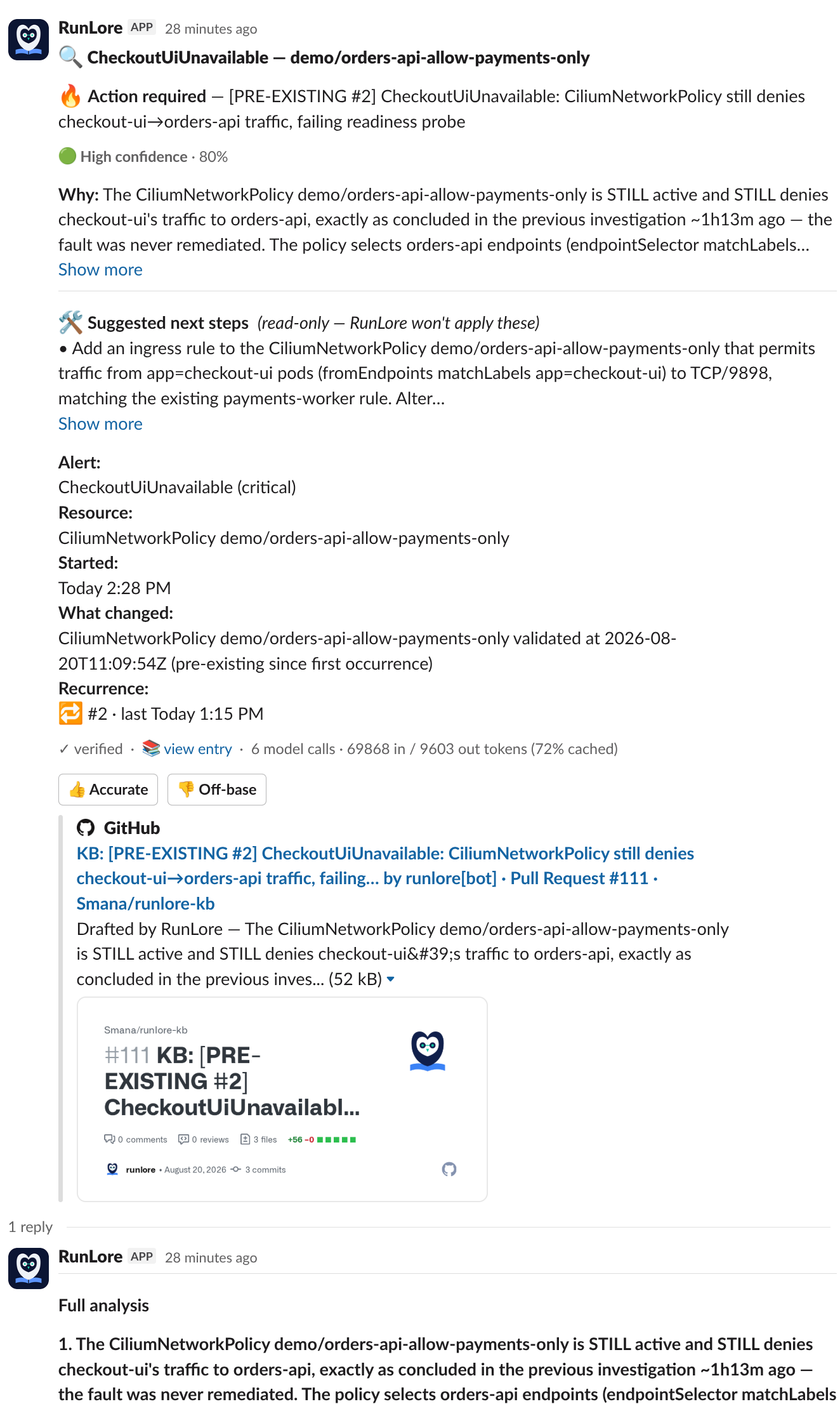
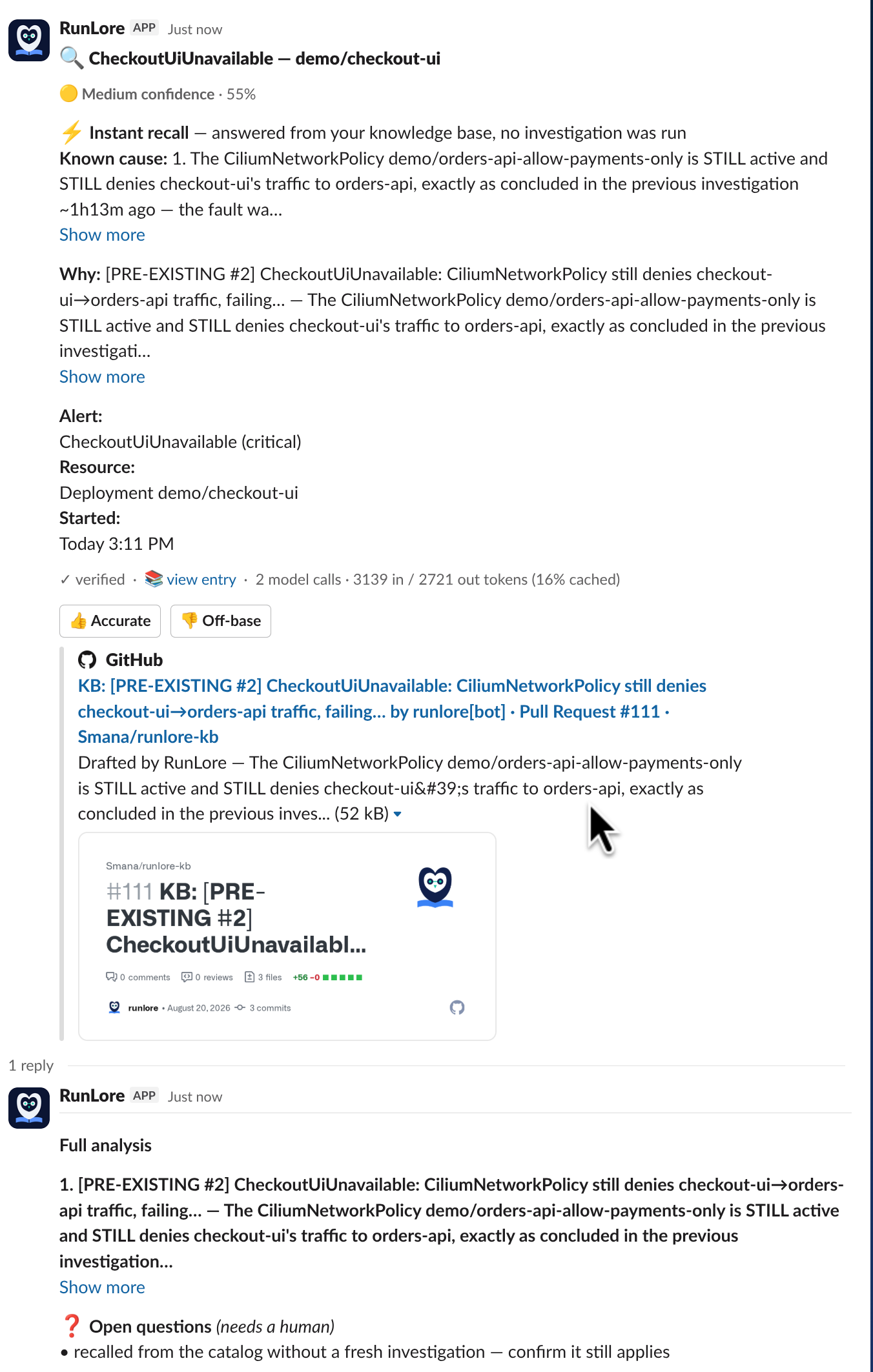
Try it before you wire anything up
Watch RunLore investigate that incident and reach that root cause on your own machine — no Kubernetes, no LLM key, no network. You only need Go.
git clone https://github.com/Smana/runlore && cd runlore && hack/demo.shIt replays a transcript recorded once against a live model through the real investigation loop — the same ReAct tool calls, verify pass and verdict renderer that run in production, over fake but realistic evidence. About a minute, most of it the Go build. See what it prints →
Knowledge you own
Every investigation opens a pull request in a Git repo you control. A human merges it. The result is portable markdown with full provenance — exportable, greppable, and yours if you stop using RunLore tomorrow.
Read-only by default
Reads your cluster, metrics, logs and network flows. Its only writes go to Git, via reviewed PRs — and it would rather say “I don’t know” than guess.
GitOps-native provenance
Turns “what changed?” into an exact Git answer — the rendered-manifest diff of the revisions Flux or Argo CD reconciled. That provenance is what makes the knowledge trustworthy.
Your models · one Go binary
A single self-hosted Go binary running in your cluster on your own model providers. Any OpenAI-compatible endpoint, or native Anthropic. No lock-in, your data. Point it at any MCP server for tools it doesn’t ship.
Its eval scorecard is published nightly, in full — per scenario, red or green.
Browse the docs
Getting Started
Deploy RunLore into a cluster and watch it react.
Concepts
The design, the learning loop, and the data sources.
Configuration
Configure the agent, its sources, and MCP.
Operations
Run, observe, troubleshoot, and upgrade.
Security
Read-only default, the action gate, the trust model.
Reference
Tools, benchmarks, and worked examples.