Design
A self-improving SRE agent that reacts to any incident — whatever the cause — investigates the likely cause by forming and testing hypotheses across your signals (sharpest at what changed, and deepest on GitOps platforms), and learns — writing every resolved incident into an open, git-versioned knowledge catalog that makes the next investigation faster.
| Status | v1 — MVP + Phase-2 learning loop shipped (React + Investigate + Learn closed end-to-end; autonomy ladder off/suggest/approve shipped, auto gated) |
| Date | 2026-06-20 |
| CLI | lore |
| Module | github.com/Smana/runlore (adjustable — could move to a dedicated org) |
| License | Apache-2.0 |
| Language | Go (single static binary) |
See also:
learning-loop.md— a focused deep-dive on how the learning loop works (retrieve → capture → curate → compound), the outcome-driven decay edge, and the design rationale behind each gate, with diagrams.
1. Why this exists
On a modern cloud-native platform (Kubernetes + a GitOps engine + a metrics/logs stack), a lot of incident investigation is already solved interactively: a human in an AI session, wired to the right MCP servers and debugging skills (a GitOps MCP, metrics/logs MCPs, and the like), can trace a failing rollout to its root cause today. Rebuilding that interactive experience would be reinvention.
Four things are not solved — and they are what RunLore is:
- Unattended operation. Every existing piece needs a human in the loop, in a session. Nothing wakes at 03:00 on an alert, investigates, and hands you a root-cause hypothesis.
- Cross-signal correlation across causes — with “what changed” as the sharpest lens. Incidents come from many causes: a deploy, but also a node/disk/cloud failure, a network/DNS issue, saturation, a dependency outage, a cert expiry, organic load. Today the GitOps engine, metrics, logs, and network are separate tools; nobody ties them into one investigation — and nobody diffs Git between the two deployed revisions to show the actual delta when a change is the cause. RunLore does both: correlates the signals, and makes “what changed” a first-class lens.
- Learning. Existing OSS agents rely on your hand-curated runbooks; they don’t accumulate knowledge. Commercial tools that “learn” are all closed.
- Shareability. None of the above is an installable product a different team can adopt.
RunLore fills exactly these gaps, and only these.
2. Positioning (honest prior art)
See prior-art.md for the full landscape. The short version:
| Capability | OSS today | Commercial today | RunLore |
|---|---|---|---|
| Autonomous react → investigate → report | HolmesGPT (CNCF); k8sgpt-operator/kagent partial | the whole market’s commodity | table stakes (we do it too) |
| “What-changed” Git-diff RCA, GitOps-/metrics-agnostic | effectively nobody (OSS is Prom/Loki/vanilla-k8s) | Komodor, Anyshift do change-diff RCA | sharp, but copyable — provenance for the catalog, not the moat |
| Open, reviewable, outcome-weighted knowledge catalog | nobody (HolmesGPT doesn’t learn; kagent’s memory is opaque) | Cleric/Resolve/PagerDuty/Google — all closed | the durable wedge |
Honest about the sub-50% reality (read-only-first, unresolved, eval-proven) | partial | mostly autonomy-theatre | the under-sold asset |
The autonomous runtime is a commodity, and the Git diff — though sharp — is now matched by Komodor and
Anyshift (see prior-art.md). The defensible reason to build RunLore is the
combination the open tools don’t have: an open, portable, PR-reviewed knowledge catalog that
learns from outcomes (HolmesGPT doesn’t learn; kagent’s memory is opaque), grounded in the exact
GitOps change, from an agent that is honest about what it can’t determine — all self-hosted, on
your models. Target user: lock-in-averse, sovereignty-conscious, GitOps-native teams.
3. Goals / Non-goals
Goals
- Autonomous, read-only-first incident investigation that a team can
helm install. - GitOps-engine-agnostic (Flux + ArgoCD) and metrics-backend-agnostic (VictoriaMetrics + Prometheus) from day one; logs/network/cloud pluggable behind the same pattern.
- A “what changed” spine (revision history + real Git diffs) as the sharpest investigation lens — co-equal with the no-change hypotheses (saturation, network, node health, dependency, load), not the only question asked.
- An open OKF knowledge catalog the agent reads (fast, cached) and writes (PR-gated) — knowledge is portable markdown in git, never vendor lock-in.
- Single static Go binary; runs in your terminal (
lore investigate) or in-cluster (lore serve). - Three model providers: Anthropic, Google Gemini, and OpenAI-compatible. The last covers an in-cluster vLLM, Ollama, OpenRouter, or any OpenAI-compatible endpoint — so data needn’t leave the boundary, with no LiteLLM-style multi-broker dependency.
Non-goals (for now)
- Unattended remediation of production. The autonomy ladder’s lower rungs are shipped
(
off/suggest/approve): inapprovethe agent executes only reversible Flux ops (suspend/resume/reconcile) after explicit human approval, validated server-side. The top rung (auto, execute without approval) exists but is gated and not recommended on real clusters (§6, §9). Default remains read-only; “writes” without an approved action mean markdown to git via reviewed PR. - Being an observability platform. RunLore reads your metrics/logs; it doesn’t store them.
- Re-implementing interactive Flux/k8s debugging that
gitops-cluster-debug+ MCPs already do. - Multi-agent / A2A orchestration. A single tight investigation loop first.
4. Core concepts
Change — the engine-agnostic unit of “what changed”. Both Flux and ArgoCD reduce to revision
history + a Git diff between revisions, so the investigator and the knowledge entries are written
against Change, never against Flux or Argo directly. (See internal/providers/providers.go.)
OKF knowledge catalog — a git repo of markdown-with-frontmatter entries (Open Knowledge Format). Bundled default runbooks ship as the initial catalog; learned incidents accrete on top. Same family as a Karpathy LLM-wiki / auto-memory.
Providers — every backend the agent touches is a pluggable interface (GitOps, Metrics, Logs, Network, Cloud, Model, Notifier, Issue). Core providers are built-in so the binary is self-contained; MCP is the extension layer (consume existing/community MCP servers as extra tools, but never require them).
5. Architecture
📐 The detailed component diagram is on the Architecture page. The ASCII sketch below is a quick text rendering.
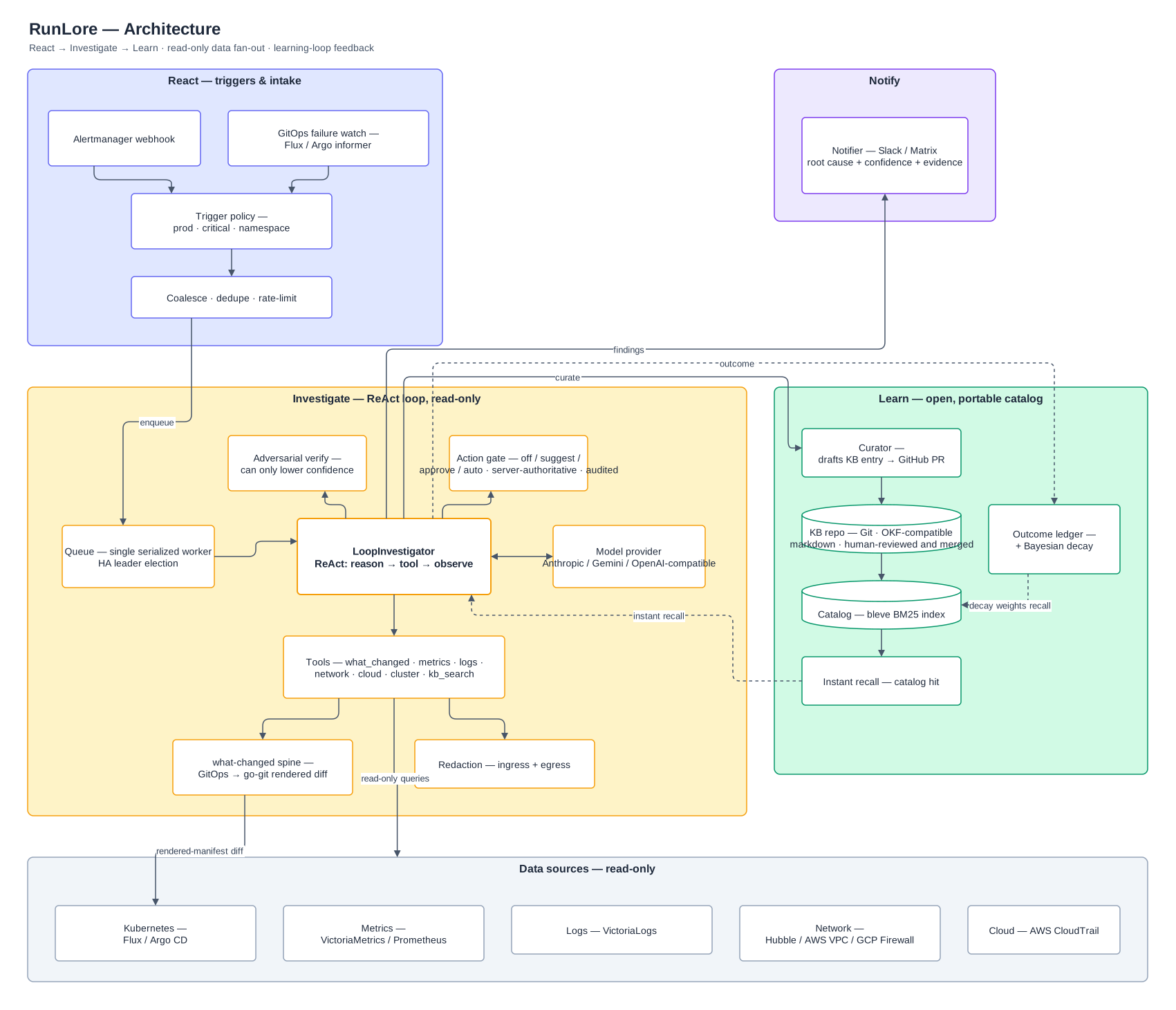
The main components map onto internal/ packages — see the illustrative layout in §13.
6. The three pillars
React — wake without a human
The primary trigger is an incident (an alert from Alertmanager/VMAlert), gated by a configurable trigger policy so RunLore investigates only what matters — not every alert. Noise, relevance, and LLM cost are all controlled here.
- Incident-triggered (primary): an HTTP endpoint receives Alertmanager/VMAlert webhooks; a
trigger policy decides which incidents start an investigation, by:
- environment (e.g.
prodonly — matched on alert labels / namespace conventions), - severity (e.g.
critical/pageonly), - namespace / team / owner, alert-name globs, and arbitrary label matchers,
- dedup / rate limits (don’t re-investigate a still-firing alert).
- environment (e.g.
- GitOps-failure-triggered (secondary):
GitOpsProvider.WatchFailures()surfacesReady=False(Flux) /Degraded/OutOfSync(ArgoCD) → catch a bad rollout before a metrics alert fires. - Proactive watch (Phase 3): periodic scan for SLO burn-rate / drift.
- On-demand:
lore investigate --alert "<symptom>"or a chat mention in Slack/Matrix (same engine, human-initiated).
Example trigger policy (internal/config, config.TriggerPolicy). Source enablement
lives under sources.<name>; the triggers block is purely the match/ignore/dedup
criteria applied to admitted alerts:
sources:                                # enablement is per-source
  alertmanager: {}                      # mount the incident webhook ingress
  gitops: { enabled: true }             # watch GitOps Ready=False (secondary trigger)
triggers:
  incidents:                            # match/ignore/dedup for admitted alerts
    match:                              # ANDed; empty fields match anything
      severity:    [critical]           # only paging-grade
      environment: [prod]               # ignore staging/dev
      namespaces:  ["apps*", "payments"]
      labels:      { team: platform }   # arbitrary label matchers
    ignore:
      alertnames:  [Watchdog, InfoInhibitor]
    dedup: { window: 30m }              # don't re-open a still-firing alert
    debounce: 60s                       # hold a NON-CRITICAL firing alert, skip it if a
                                        # matching resolved webhook lands within the window
                                        # (default 60s; 0s = investigate on every fire).
                                        # A `critical` alert is NEVER held — a debounce
                                        # must never delay the first look at a page.
    cancel_queued_on_resolve: true      # default. Drop a QUEUED (not yet started)
                                        # investigation when the alert resolves first —
                                        # this, not the hold, is what filters a
                                        # self-resolving CRITICAL, at zero added latency
  gitops_failures:                      # secondary trigger (enabled via sources.gitops)
    debounce: 60s                       # require the failure to persist this long
                                        # (re-check still Ready=False) before
                                        # investigating — filters reconcile-churn
                                        # transients; 0 = fire immediately
Investigate — form & test hypotheses across causes
The cause is unknown at wake time, so RunLore explores a hypothesis space, not a fixed pipeline: what changed (the sharpest first question) and the causes nothing changed for (saturation, network drops, node/disk health, dependency outages, organic load). “What changed” spans more than GitOps — deploys, config, images, infra/cloud, autoscaling, cert rotation, manual changes — and on a GitOps platform it resolves to the exact Git diff (the spine below).
- Instant recall:
kb_search(symptom)against the cached catalog. High-confidence known-pattern hit → short-circuit to the known resolution (no full loop). (HolmesGPT data: ~40 % of incidents self-resolve on a runbook/pattern match; tool-calls drop 16→2.) - What changed: build the ranked
Changetimeline around the incident window — the Git diff on a GitOps platform (what_changed, resolving GitRepository/OCIRepository/ExternalArtifact sources) and the AWS control plane (cloud_what_changed= CloudTrail), unified in oneChangemodel so an infra change outside GitOps lands on the same timeline. - Ground: retrieve relevant OKF runbooks/incidents and seed the loop.
- ReAct: pull metrics (PromQL), logs, network, Flux status/tree, controller logs, and cloud resource health just-in-time via providers; form and test hypotheses across both the change-caused and no-change branches.
- Adversarial verify pass: before delivery a skeptic model call re-examines each root cause and
rejects correlation-only findings (moving them to
unresolved) and re-calibrates confidence. It can only ever lower/withdraw a claim, never invent one — and if it rejects every root cause, the proposed actions are dropped too. Recalled (catalog) findings go through it as well, since catalog content is untrusted. - Output contract (structured): ranked root cause(s) + confidence +
change_ref+ evidence trail + suggested reversible action + explicitunresolved(honest about what it couldn’t determine — designed for the ITBench <50 % reality, §10).
Learn — compound an open catalog
The full operational mechanics — instant-recall trust gates, the outcome ledger, outcome-driven decay, curation, and compounding — are documented once in learning-loop.md (the canonical deep-dive). This section is the architectural view: how Learn fits the design and why.
RunLore’s learning is modeled on the Open Knowledge Format (OKF) introduced by
GoogleCloudPlatform/knowledge-catalog:
a git tree of markdown + YAML-frontmatter entries that agents both read and write (its enrichment
agent follows a read existing → generate entries → human pushes loop). RunLore applies that pattern
to incidents. The loop is retrieve → capture → curate → compound, routed by confidence:
investigation result
  ├─ KB hit (known)          → post the known resolution. No issue, no PR. (instant recall)
  ├─ novel + confident       → draft OKF entry as a PR; humans refine via review → merge → reindex
  └─ novel + uncertain       → chat-only: the findings + open questions are delivered to chat, but
                               NO repo artifact is written — a below-bar guess must not enter the catalog
The catalog only grows from genuinely novel, human-sharpened incidents. (Issues are opened only by the scheduled Phase-2 grooming, and only for a recurring unresolved pattern — a “knowledge gap”, never for a one-off uncertain finding.) Every learned entry cites its evidence trail, the causing change, and the fixing change — provenance no closed “memory” gives you.
Lifecycle labels gate the catalog’s quality. Curated artifacts carry a lifecycle label —
triggered (raw, just opened) → investigating → solved (root cause confirmed and resolution
captured) — plus wontfix. Only a solved entry with a written resolution should be merged as a
reusable Playbook, so unverified findings can’t silently become “knowledge.”
Re-running on demand (reinvestigate). RunLore takes no inbound GitHub webhooks, so re-triggering is
an outbound poll: a human adds the reinvestigate label to a curated issue; the leader re-runs the
investigation (with the prior finding as context), comments the fresh result, and advances the label to
investigating. Only RunLore-originated issues (carrying the runlore provenance label) are eligible —
a drive-by issue can’t spend an investigation.
Two kinds of knowledge — seeded vs learned (a deliberate distinction). “Learns your context” is only half emergent:
- Seeded (authored / ingested, not conjured from RCA): your constraints, architecture &
tooling, and workflows & procedures — e.g. “never restart the payments DB in market hours,”
“egress is a single NAT, so DNS flakes look like app errors,” “cap-touching changes escalate to
platform.” These come from your existing runbooks, ADRs, wiki, and
AGENTS.md, ingested as OKF entries — making the agent context-aware on day one, not after a slow accumulation. - Learned (emergent from investigations): incident patterns (“this symptom → this cause → this fix”), captured via the loop above.
To keep the catalog an asset and not a liability (frontier RCA is <50 % accurate, §10), every entry
carries lifecycle frontmatter that recall now honours: status — a retired/draft entry is
indexed but never fires or leads (the seam the retirement pass writes to, learning-loop.md §5) — and
last_validated — recall down-weights an entry no human has confirmed within a configurable
horizon (catalog.instant_recall.stale_after; one confidence step, never a rejection). Both are
fail-safe: an absent or unknown value reproduces the pre-field behaviour exactly. A third key,
confidence, is written by the curator but deliberately not read back — recall derives trust
from the live outcome track record (resolve rate + 👍/👎), and a static authored confidence would fight
that dynamic signal. On top of these, an outcome-driven decay down-weights knowledge that stops
resolving incidents (mechanics in learning-loop.md §6).
Curation — the PR/issue review — is the load-bearing quality gate that separates this from opaque
vendor “memory.”
Act — the (gated) autonomy ladder
Read-only is the default posture, not the ceiling. RunLore climbs an autonomy ladder as eval earns trust — an action is just a tool with extra metadata behind a policy gate:
read-only  →  suggest (PR/command)  →  approve-to-execute (human click)  →  bounded auto
rung 0         rung 1                   rung 2                              (reversible + low-blast
(default)      (v1, shipped)           (v1, shipped)                       + non-critical only;
                                                                            gated, not recommended)
Every action tool declares mutating / reversible / blastRadius / target; an action policy
(mirroring the trigger policy) sets the mode (off | suggest | approve | auto), scoped by
environment, reversibility, and blast radius. Rungs off/suggest/approve are wired in v1: in
approve, an approved decision executes a reversible Flux op (suspend/resume/reconcile), with
reversibility/blast-radius/target validated server-side (internal/action) — never trusted from
model output. Rung auto (execute without approval) exists but is gated (reversible-only,
confidence-thresholded, rate-limited, kill-switchable, off by default) and is not recommended on
real clusters. The metadata (providers.Action, config.ActionPolicy) was in place from day one, so
none of this was a retrofit.
Decision (2026-06-24) — no in-cluster mutating
rollback. A reversible “re-pin to the prior revision” op was scoped and rejected. The executor today runs only namespace-scoped, single-resource Flux ops (suspend/resume/reconcile). A real GitOps rollback can’t fit that shape cleanly:
- It fights the protected-namespace model. A Flux Kustomization has no per-resource revision pin, so re-pinning it must patch its owning GitRepository — which in the common monorepo layout lives in
flux-system, a built-in protected namespace the action gate forbids as a target. The only ways past that all weaken a safety invariant.- It is anti-GitOps. An in-cluster re-pin makes the cluster’s desired state diverge from Git: Flux then reports drift, the next legitimate Git change collides with the manual pin, and the divergence must be remembered and undone.
- Little is lost. The agent already suggests a rollback in
suggestmode (“roll backappstoabc123”); only the act of executing it is withheld. For a GitOps shop, “the agent advises, a human merges the revert” is the correct division of labor — and the upside is modest against the outage risk of a wrong rollback on a sub-50%-RCA baseline.If the loop is ever closed, the GitOps-correct form is a Git-revert PR (reuse the curator/forge path) — in sync with Git, inherently reversible, reviewed — not a cluster patch. Until then, remediation stays read-only / propose-and-approve, and the autonomy ladder’s executable vocabulary remains the three reversible Flux ops above.
7. Provider abstraction
Interfaces live in internal/providers/providers.go. “For the moment” impls:
| Provider | Interface | Impls now | Later |
|---|---|---|---|
| GitOps | GitOpsProvider | Flux, ArgoCD | — |
| Metrics | MetricsProvider | VictoriaMetrics, Prometheus (one PromQL impl, 2 endpoints) | — |
| Logs | LogsProvider | VictoriaLogs | Loki, … |
| Network | NetworkProvider | Cilium Hubble, AWS VPC Flow Logs, GCP Firewall Logs (pluggable, CNI-agnostic; none default-on) | Azure NSG Flow Logs; CNI-agnostic eBPF (Retina) |
| Cloud | CloudProvider | AWS (CloudTrail what-changed + EC2/ASG/EKS health), GCP¹ (Cloud Audit Logs what-changed + GKE/MIG/Compute health, Workload Identity direct principal binding) | Azure via native SDKs; Steampipe/cloud-MCP optional |
| Model | ModelProvider | Anthropic, Gemini, OpenAI-compatible (in-cluster vLLM, Ollama, OpenRouter, …) | — |
| Notifier | Notifier | Slack, Matrix | PagerDuty, incident.io |
| Issue | IssueProvider | GitHub (App auth) | GitLab (access token) |
¹ GCP starts and authenticates on live GKE; its lenses’ responses are still unobserved. A first run on GKE Standard 1.35.6 with self-managed Cilium (#562) confirmed three-tier identity resolution (the metadata server answered, so tier 3 contributed nothing) and that a Workload Identity direct principal binding passes the preflight. What remains unobserved is a real Cloud Logging or Container API payload: the tests run against
httptestfixtures hand-written from the API reference, so response shapes are plausible rather than captured. See GCP cloud control plane for what is settled and what is not — Autopilot, which decides whether the node-tier fallback survives, is untested.
Cloud via native SDKs. The AWS impl (
internal/providers/cloud/aws,aws-sdk-go-v2) is read-only:CloudChanges= CloudTrailLookupEvents(mutating events → the engine-agnosticChangemodel, so cloud joins the same “what changed” timeline as Git diffs);ResourceHealth= EC2/ASG/EKSDescribe. Auth is in-cluster identity (EKS Pod Identity / IRSA via the default credential chain) — not static keys, not Steampipe, not shelling out to cloud CLIs (both add heavy deps and break the single-binary property). GCP (internal/providers/cloud/gcp) follows the same shape —CloudChanges= Cloud Audit Logsentries.listover theactivity/system_eventstreams,ResourceHealth= GKE/MIG/Compute Engine describes, auth a Workload Identity direct principal binding (no GSA, no ServiceAccount annotation). Both lenses are implemented andwireCloudProviderwires the provider intoserve; what is missing is an investigation that actually calls the lenses on a live cluster (see the footnote above). Azure would follow the same shape too, once started. Steampipe and cloud MCP servers remain available as optional MCP extensions.On Cilium clusters the credential endpoint needs its own
CiliumNetworkPolicy, and the two clouds need different rules.networkPolicy.awsPodIdentityrenderstoEntities: [host]— the EKS Pod Identity agent (169.254.170.23:80) really does run on the node host network, which a Kubernetes NetworkPolicy can’t match.networkPolicy.gcpWorkloadIdentityrenderstoCIDR: 169.254.169.254/32instead, because Cilium does not classify the GKE metadata server as thehostentity: a shared rule was tried, matched nothing, and dropped every metadata call (#562).
Why the GitOps abstraction is real, not hand-wavy — both engines reduce to revision history + git diff:
| Flux | ArgoCD | |
|---|---|---|
| revision history | HelmRelease/Kustomization .status.history + lastAppliedRevision | Application.status.history[] |
| deployed now | source GitRepository revision | status.sync.revision |
| failure (React) | Ready=False, source FetchFailed | health=Degraded, sync=OutOfSync |
| the diff | go-git between revisions over spec.path | go-git over source.path (Argo also has native app diff) |
Engine depth — deep lens now at parity. Flux is the reference implementation, but the deep introspection tools (
gitops_resource_status,gitops_tree) and the failure-persistence re-check run on theGitOpsInspectorinterface, which both Flux and Argo CD now implement (FEAT-2): on Argo via nativestatus.health/status.sync, error conditions, and thestatus.resourcestree (app-of-apps aware). Remaining honest asymmetry: action-approval (rung-2) is Slack-only today; Matrix is delivery-only.
Auto-discovery: detect argoproj.io/Application → ArgoCD; helm.toolkit.fluxcd.io → Flux; probe
the metrics endpoint → VM vs Prometheus. Config overrides. Flux + VictoriaMetrics is the primary
reference combo; Argo + Prometheus exercises the abstraction.
8. The knowledge catalog & its cache
Source of truth = a git repo — an
OKF bundle (markdown + YAML frontmatter;
index.md + log.md reserved; entries link to assert relationships). Reviewed, versioned, portable.
The agent never queries git at investigation time. A Catalog subsystem keeps it fast:
KB git repo  ──syncer──►  local mirror  ──build──►  index:  bleve (BM25)  [+ opt-in vectors: cosine + RRF]
  (truth)    (poll HEAD ±webhook/Receiver)              ▲
kb_search(query, k) — in-process, sub-ms, no git/network- Syncer polls remote
HEAD(cheap), pulls on change, incrementally re-indexes changed entries. Optional push-webhook / FluxReceiverfor instant refresh. - Index is embedded + persisted:
bleve(BM25) — no embedding dependency, genuinely “easy”. Hybrid vector recall (opt-in,catalog.instant_recall.hybrid) is already implemented as an in-process cosine + RRF fusion over a persisted vector cache (internal/embed,internal/catalog/hybrid.go) — no vector-DB dependency; embeddings are served by the in-cluster vLLM. Both pure-Go → the single binary holds the whole retrieval stack. - Sync mechanism (default A; B is the in-cluster upgrade):
- A — built-in self-syncer (poll + optional webhook). Fewest moving parts. Default.
- B — Flux
GitRepository+Receiver— the KB syncs like every other source; Flux notifies a reload. - C —
git-syncsidecar + shared volume — classic decoupling.
9. Safety & trust model
Read-only by default; execution is gated and server-authoritative. Read-only is the default posture. When the autonomy ladder is enabled (
config.actions), the executor runs only a fixed set of reversible Flux ops (suspend/resume/reconcile); reversibility, blast radius, and the target namespace are validated server-side (internal/action) — derived from the op, never trusted from model output — and an unknown op or out-of-allowlist target is refused. No cluster-mutating MCP tools are wired. The alert webhook is authenticated (required underauto), and the kill-switch fails closed on cold start (auto starts paused until an authenticated resume). Note: the kill-switch resume and the rate-limit window are in-memory — a restart/failover re-pauses (safe) but loses an operator’s resume and resets the rate-limit counter; back them with a PVC if resume/budget must survive a restart.The Curator is cluster-read-only — its “writes” are markdown-to-git via reviewed PR + issues, never the cluster. Cluster mutations come only from the gated action executor above.
Scoped identity. In-cluster, the agent runs under a least-privilege, read-mostly identity (a scoped ServiceAccount; or EKS Pod Identity / Workload Identity on managed clusters). Execution rights (
patch) are granted as namespace-scoped Roles over an allowlist, never cluster-wide.Raw pod logs are namespace-scoped, not cluster-wide.
controller_logsreads raw pod log bodies (which can carry secrets/PII) only from the Flux controllers, sopods/logis granted as a namespaced Role overrbac.controllerLogNamespaces(defaultflux-system) — never cluster-wide. Cluster-widepods/eventsget/list (pod status + event messages, not log bodies) stays in the ClusterRole becausepod_status/kube_eventstriage arbitrary incident namespaces.Secret redaction at the model and egress boundaries (
internal/redact). Secret-shaped values are masked at three trust boundaries before they can leave the cluster: the incident text entering the prompt, every tool output (logs, git diffs, status/event messages) before it reaches the model provider, and the finished investigation (root-cause summaries, evidence, suggested actions) before it is copied into the KB pull-request body and chat. The ruleset is high-precision — PEM private keys, JWTs, GitHub / Slack / AWS / Google / Stripe keys,user:pass@hostURLs,Authorizationheaders, and generic*secret*/*token*/*password*: <value>pairs, plus the values under akind: Secretmanifest’sdata:/stringData:block (including inside a git diff; the values are also base64-decoded and scrubbed from the whole payload) — masking the value while keeping surrounding structure so the agent can still reason (“the password field changed”). Redaction is a mitigation, not a guarantee: unlabeled high-entropy strings and base64 blobs with noSecretmanifest in the payload are not caught (see the LLM security architecture). Defense-in-depth still applies — the RBAC scoping above limits what tool output can contain, and self-hosting the model (in-cluster vLLM/Ollama) keeps data in-boundary regardless. If you run a public KB repo or untrusted-tenant namespaces, treat the residual recall gaps as a gating concern.Append-only, tamper-evident audit log (
internal/audit): every action attempt — inputs, gate results, op, target, actor, outcome — is a hash-chained JSON line, so edits/deletions are detectable.Honest uncertainty.
unresolvedis a first-class output field; the agent says what it doesn’t know rather than hallucinating. The autonomy ladder. Read-only is the default rung, not the ceiling. Action tools are gated by an action capability model + action policy (providers.Action+config.ActionPolicy):every action declares
mutating/reversible/blastRadius/target;the policy sets the mode (
off | suggest | approve | auto), scoped by environment, reversibility, and blast radius — irreversibility is the trip-wire for mandatory human approval;dry-run / preview by default, append-only audit, and reversibility for anything applied;
scoped agent identity (RBAC) is the hard backstop regardless of policy.
off/suggest/approve are shipped in v1 (the executor runs only reversible Flux ops, behind
human approval); auto exists but is gated and not recommended on real clusters. The capability
metadata was present from day one, so reaching the higher rungs needed no retrofit.
10. Evaluation
The independent benchmark (ITBench, IBM/ICML 2025) found frontier models identify the root cause < 50 % of the time and fully resolve ~11–14 % of real K8s incidents. RunLore treats sub-50 % as the baseline and makes failure handling a first-class primitive.
- Deterministic core is unit-tested: the
Changetimeline +diff_revisionsare mechanical → Go table tests over recorded cluster+Git fixtures. No flaky LLM scoring for the spine. - Replay harness (
lore eval): snapshot real past incidents (your metrics/logs history), replay them offline, score end-state root-cause identification via LLM-as-judge. Optionally driven bypromptfoo. - Ship the eval harness so users can trust the agent against their incidents and contributors can’t regress it.
11. Tech stack
- Go 1.26, single static binary (
goreleaser/kofor images). client-go(Flux/Argo CRDs, k8s),go-git(revision diffs),bleve(BM25 index).- Everything else is hand-rolled — deliberately, to keep one static binary with no SDK sprawl:
the CLI is a stdlib
switch os.Args[1](no cobra); the MCP server and client are dependency-free (internal/mcpspeaks streamable-HTTP directly); the model clients (internal/model/{anthropic,openai,gemini}) arenet/httpagainst the raw provider APIs; and vector recall is an in-process cosine + RRF fusion (internal/embed), not a vector-DB dependency. - Distribution: single binary + container image + Helm chart (
deploy/helm/runlore).
12. Phased roadmap (read-only by default; autonomy ladder’s lower rungs shipped)
| Pillar | Phase 1 (MVP) | Phase 2 | Phase 3 | Phase 4 |
|---|---|---|---|---|
| React | Incident-triggered (Alertmanager/VMAlert) + trigger policy (env/severity/namespace/label filters + dedup) | + GitOps-failure events, chat mention (Slack/Matrix), lore investigate | + proactive SLO-burn watch | — |
| Investigate | what-changed spine + VM/VL/Hubble correlation + OKF-runbook grounding + confidence/unresolved | + ArgoCD + Prometheus providers proven | + cloud context (native SDKs: AWS/GCP/Azure) + cross-incident pattern recognition | — |
| Learn | catalog read (cached index, instant recall) | catalog write (confidence-routed Issue/PR curation) — loop closes | hybrid vector retrieval, auto-curated playbooks, postmortems | — |
| Act | rung 0: read-only (default) | shipped: suggest + approve-to-execute (reversible Flux ops, human-approved, server-authoritative); auto exists but gated/not recommended | — | further rungs as eval earns trust (policy-gated) |
Phase 1 headline: an alert fires → RunLore investigates by correlating what-changed with metrics/logs → posts a confidence-scored RCA + suggested rollback to chat (Slack/Matrix), grounded in the catalog.
13. Repo layout
cmd/lore/                      CLI / agent entrypoint
internal/
  config/                      config + auto-discovery of providers
  investigate/                 the ReAct investigation loop + output contract
  whatchanged/                 revision history + go-git diffs → []Change (the spine)
  catalog/                     syncer + local mirror + bleve BM25 (+ opt-in vector) index + kb_search
  curator/                     confidence-routed Issue/PR crystallization → OKF entries
  curate/                      Phase-2 backlog groomer (dedup, lifecycle, retirement sweeps)
  outcome/                     outcome ledger — Beta-posterior decay over resolve/vote counts
  audit/                       append-only decision/tool-call log
  model/                       ModelProvider impls (anthropic, gemini, openai-compatible)
  notify/                      Notifier impls (slack, matrix; pagerduty/incident.io later)
  providers/
    providers.go               the interfaces + the Change model (the contract)
    gitops/{flux,argocd}/      GitOpsProvider impls
    metrics/                   MetricsProvider (PromQL: vm | prometheus)
    logs/victorialogs/         LogsProvider
    network/hubble/            NetworkProvider
    cloud/{aws,gcp,azure}/     CloudProvider — native SDKs, Phase 2+ (Steampipe/MCP optional)
deploy/helm/runlore/           in-cluster chart (Phase 2)
examples/runbooks/             seed OKF catalog (ships as default knowledge)
docs/                          design.md, learning-loop.md, getting-started.md, … (see the Docs index)
14. Open questions & risks
Git & forge auth — a GitHub App (best practice; one fine-grained, short-lived identity for both needs):
contents: read→ clone/diff the GitOps source repo(s) for the what-changed spine;issues: write+pull_requests: write+contents: write(KB repo) → the Curator.
The App mints 1-hour installation tokens (no long-lived PAT; bot identity; central revoke). The installation token also works as the git HTTP password (
x-access-token:<tok>@github.com/…), so the same App serves clone/diff and API writes. The private key lives in a k8s Secret (ideally via External Secrets), referenced — never inlined:forge: github_app: app_id: 123456 installation_id: 7891011 private_key_ref: runlore-github-app # Secret name/keyNon-GitHub hosts (GitLab, self-hosted) fall back to a scoped access token / deploy key — auth is per-host. Local
lore investigatecan use ambient git credentials instead of the App.Embedding model for vector search — hybrid vector recall is now implemented (opt-in, in-process cosine + RRF, embeddings from the in-cluster vLLM); the remaining question is which embedding model to standardize on.
Multi-replica index — v1 single-replica with a local index; later, shared PVC or per-replica rebuild from the mirror.
Noise control — only novel/unresolved investigations open issues; instant-recall short-circuits known patterns so the KB (and your issue tracker) don’t get spammed.
HolmesGPT overlap — accepted. Differentiation is GitOps-/metrics-agnostic + what-changed spine
- the open learning catalog; not the runtime.